



How to Choose the Best Whole House Water Filter for Your Home
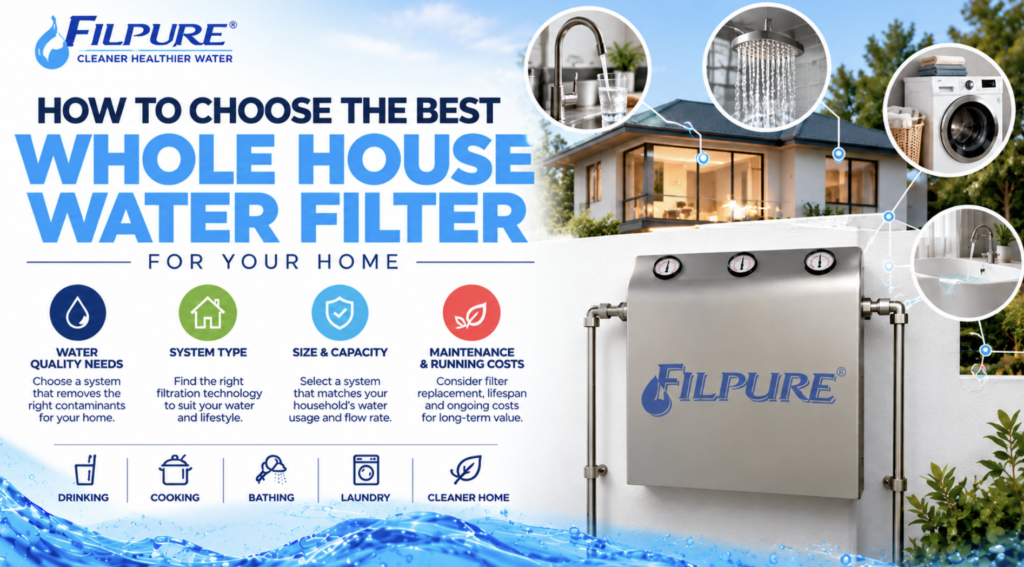
Choosing the right water filtration system is an important decision for homeowners who want to improve water quality throughout their property.
With different filtration technologies, system sizes, cartridge options and installation requirements available, knowing where to begin can sometimes feel overwhelming.
A whole house water filter provides a convenient way to treat water at the main supply point before it reaches multiple household outlets.
However, not every system is designed for the same water conditions or household requirements.
Some systems focus on sediment reduction, while others combine activated carbon and specialised filtration media to address additional water quality concerns.
The best whole house water filter is not necessarily the most expensive or the one with the greatest number of filtration stages. It’s the system that suits your water supply, household usage and filtration goals.
In this buying guide, we’ll explain what to look for when comparing whole house water filters, how to assess different filtration options and the common mistakes to avoid before making a purchase.
1. Identify What You Want to Improve About Your Water
Before comparing products, the first step is understanding why you want a water filtration system.
Different households have different concerns, and these should guide the type of filtration equipment you choose.
Chlorine Taste and Odour
If your water has a noticeable chlorine taste or smell, an activated carbon filtration system may be appropriate.
Activated carbon is commonly used to reduce chlorine-related taste and odour, making water more pleasant for drinking and everyday household use.
Sediment and Visible Particles
If you notice small particles, dirt or rust in your water, sediment filtration may be useful.
Sediment filters are designed to capture suspended particles before they travel through household plumbing.
Particular Water Contaminants
Some homeowners are concerned about specific substances in their water supply.
These concerns may require specialised filtration media or additional treatment technologies.
Where a particular contaminant is suspected, water testing and an assessment of the system’s verified capabilities can help determine the appropriate solution.
Hard Water and Mineral Scale
If your main concern is mineral scale accumulating around taps, showerheads or appliances, it’s important to understand that standard sediment and carbon filters do not necessarily address water hardness.
Water softening or another suitable treatment method may be required.
Identifying the actual problem helps prevent purchasing a system that does not deliver the intended results.
2. Choose the Right Type of Whole House Filtration System
Once you’ve identified your water quality concerns, the next step is choosing a suitable filtration configuration.
Single-Stage Filtration
A single-stage system uses one primary filtration stage.
This can be appropriate when the filtration objective is relatively straightforward, such as reducing visible sediment.
Single-stage systems may also offer a simpler maintenance arrangement, depending on the equipment.
Dual-Stage Filtration
Dual-stage systems typically combine two filtration processes.
For example, one cartridge may capture sediment while another contains activated carbon for chlorine taste and odour reduction.
This arrangement can be suitable for households wanting to address two common water quality concerns.
Triple-Stage and Multi-Stage Filtration
Multi-stage systems use several filtration stages to address different treatment requirements.
These may include sediment filtration, activated carbon and specialised media.
A multi-stage arrangement can provide a broader treatment approach when the filtration components are appropriately selected.
However, more stages do not automatically guarantee superior water quality.
The important consideration is whether the stages are suitable for the substances you want to reduce.
Filpure offers a selection of whole house water filters, including different high-flow and multi-stage configurations for homeowners to compare.
3. Consider the Size of Your Home and Household
Household size can influence the filtration system required.
A smaller property with one bathroom may have different water demands from a larger home with several bathrooms and multiple occupants.
When comparing systems, consider how many people live in the property and how frequently water is used.
It’s also important to think about simultaneous usage.
For example, water demand increases when multiple showers, taps and appliances operate at the same time.
A filtration system should be capable of supporting the expected peak water demand without creating excessive pressure loss.
Choosing a system based solely on the number of occupants may not provide the complete picture.
The plumbing layout, available pressure and expected water usage should also be considered.
4. Check the System’s Flow Rate
Flow rate is one of the most important technical specifications when selecting a whole house water filter.
It describes the volume of water that can pass through the filtration system over a given period.
A system with insufficient flow capacity may restrict water delivery when several outlets operate simultaneously.
This can result in reduced pressure at taps and showers.
When reviewing flow rate, consider:
- The number of bathrooms in the home.
- The likelihood of simultaneous water usage.
- The water pressure available at the property.
- The filtration system’s rated operating conditions.
- The effect of cartridge loading as filters collect sediment.
A system should be sized according to realistic household demand rather than simply selecting the largest available model.
5. Understand the Different Filtration Technologies
Not all water filtration systems use the same treatment methods.
Understanding the basic differences can help you compare products more effectively.
| Filtration technology | Main purpose |
| Sediment filtration | Captures suspended dirt, sand, rust and other particles |
| Activated carbon | Reduces chlorine taste and odour and certain other substances |
| Specialised filtration media | Targets particular substances according to product specifications |
| UV treatment | Inactivates susceptible microorganisms under suitable operating conditions |
| Water softening | Reduces hardness minerals using an appropriate treatment process |
A filtration system may use one or more of these technologies.
For example, a homeowner concerned about sediment and chlorine taste may benefit from a combination of sediment and activated carbon filtration.
A property with different water quality concerns may require another configuration.
To understand the filtration process in greater detail, read our supporting guide, How Do Whole House Water Filters Work? Understanding the Different Filtration Systems.
6. Review Filter Replacement and Maintenance Requirements
The initial purchase price is only one part of the cost of owning a whole house water filtration system.
Filters require regular maintenance to continue operating effectively.
Before choosing a system, investigate the replacement cartridge requirements.
Consider how frequently the filters may need to be changed, whether replacement cartridges are readily available and how accessible the system will be for servicing.
Some filtration arrangements may have multiple cartridges with different replacement schedules.
It’s also worth considering the time and cost involved in routine maintenance.
A system that is easy to service may provide a better long-term ownership experience.
Filpure also offers replacement filtration products, making cartridge availability an important consideration when reviewing its range.
7. Check Installation Requirements Before Purchasing
Whole house water filters are typically installed at the main water supply entry point.
This means the installation must be suitable for the property’s plumbing arrangement.
Before purchasing, consider where the system will be positioned.
The installation area should provide sufficient space for the filter housings and allow convenient access for future maintenance.
The equipment may also require protection from direct sunlight, extreme temperatures or other unsuitable conditions, depending on the manufacturer’s instructions.
A qualified plumber should assess the installation requirements, including pipework, pressure and any necessary valves or fittings.
Planning the installation before purchasing can help avoid selecting equipment that is unsuitable for the available space or plumbing configuration.
8. Compare Filtration Performance, Not Just Product Features
When comparing water filters, it’s easy to focus on features such as the number of stages, housing size or marketing descriptions.
However, filtration performance is more important than the number of advertised features.
Look for clear information about what the system is designed to reduce.
For example, a product may specify sediment filtration, chlorine reduction or treatment for particular contaminants.
Where relevant, check whether performance claims are supported by recognised testing or certification.
It’s also important to understand that a filter’s performance can vary depending on flow rate, incoming water conditions and cartridge maintenance.
A system should be assessed according to the water quality concerns it is intended to address.
9. Consider the Long-Term Value of the System
The best whole house water filter should provide an appropriate balance between performance, convenience and ongoing cost.
A lower-priced system may be suitable for a straightforward filtration requirement.
However, homeowners with more complex needs may benefit from a different configuration.
When comparing long-term value, consider the initial equipment cost, installation, replacement cartridges, servicing and expected operating requirements.
A suitable filtration system may also reduce reliance on bottled water or multiple individual filtration units.
However, potential savings will depend on household habits and the total cost of ownership.
Rather than focusing exclusively on the purchase price, assess whether the system delivers the filtration capabilities your household actually needs.
10. Choose a Water Filtration Supplier That Can Help You Compare Options
Choosing the right supplier can be just as important as choosing the filtration equipment.
A knowledgeable supplier should be able to explain the differences between filtration systems and help identify options suited to your requirements.
At Filpure, homeowners can explore a range of water filtration solutions, including high-flow whole house systems and multi-stage filtration options.
The available range includes systems designed for different treatment objectives, allowing customers to compare filtration technologies and system configurations.
When reviewing the options, consider asking about:
- The filtration stages included.
- The substances each stage is designed to reduce.
- Recommended flow rates.
- Installation requirements.
- Replacement cartridge availability.
- Ongoing maintenance and servicing.
These questions can help you make a more informed purchasing decision.
Common Mistakes to Avoid When Buying a Whole House Water Filter
Choosing a filtration system becomes easier when you understand some of the most common purchasing mistakes.
Choosing Based on Price Alone
A lower purchase price does not necessarily mean better value.
A system must be suitable for the water quality concerns and household usage requirements.
Assuming Every Filter Removes the Same Substances
Different filtration technologies perform different functions.
Always review the stated treatment capabilities before purchasing.
Overlooking Flow Rate
An undersized system may restrict water flow when several outlets are used simultaneously.
Forgetting About Maintenance
Replacement cartridges and servicing are ongoing requirements.
A filtration system should be practical to maintain over time.
Buying Without Considering Installation
The available installation space, plumbing arrangement and water pressure can influence which system is suitable.
Addressing these considerations early can help avoid unnecessary complications.
Whole House Water Filter Buying Checklist
Use this checklist when comparing systems for your home.
Your buying checklist
0 of 10 completed
Identify the water quality issues you want to address
Check whether water testing is required
Compare suitable filtration technologies
Consider household size and peak water demand
Review flow rate and pressure requirements
Check installation space and plumbing suitability
Confirm filter replacement costs and availability
Review relevant performance specifications
Consider total ownership and maintenance costs
Seek professional advice before installation
Copy checklist
Frequently Asked Questions About Choosing a Whole House Water Filter
What is the best whole house water filter for a family?
The best system depends on household water usage, incoming water quality and the substances you want to reduce. A properly sized multi-stage system may suit some families, but the appropriate configuration should be assessed individually.
Is a three-stage water filter better than a two-stage system?
Not necessarily. The value of additional filtration stages depends on their purpose and suitability for the water supply.
How do I know what size water filter I need?
Consider the property’s peak water demand, number of bathrooms, available water pressure and the system’s rated flow capacity. Professional advice can help determine the appropriate size.
Can a whole house filter replace an under-sink filter?
It depends on the filtration objectives. A whole house system may address general household water concerns, while an under-sink system can provide additional treatment for drinking water.
Should I test my water before choosing a filter?
Water testing is particularly useful when you suspect a specific contaminant or are uncertain about the quality of your water supply.
Find the Right Whole House Water Filter for Your Home with Filpure
Choosing the best whole house water filter comes down to understanding your water quality concerns and selecting a system that meets your household’s needs.
From filtration technology and flow rate to installation and maintenance, taking the time to compare your options can help you make a more confident purchasing decision.
For homeowners looking to improve water quality across multiple household outlets, Filpure offers a range of whole house filtration solutions worth exploring.
Ready to find a water filtration system that suits your home?
Browse Filpure’s Whole House Water Filters collection and enquire about a suitable system for your household.
Search
Blogs

Get Your Water Filter Today – Because Health Can’t Wait!
Prioritize your health — get your water filter today and start living a healthier life. Pure water in every sip, better living every day!
FROM THE AUTHOR