



How Do Whole House Water Filters Work? Understanding the Different Filtration Systems
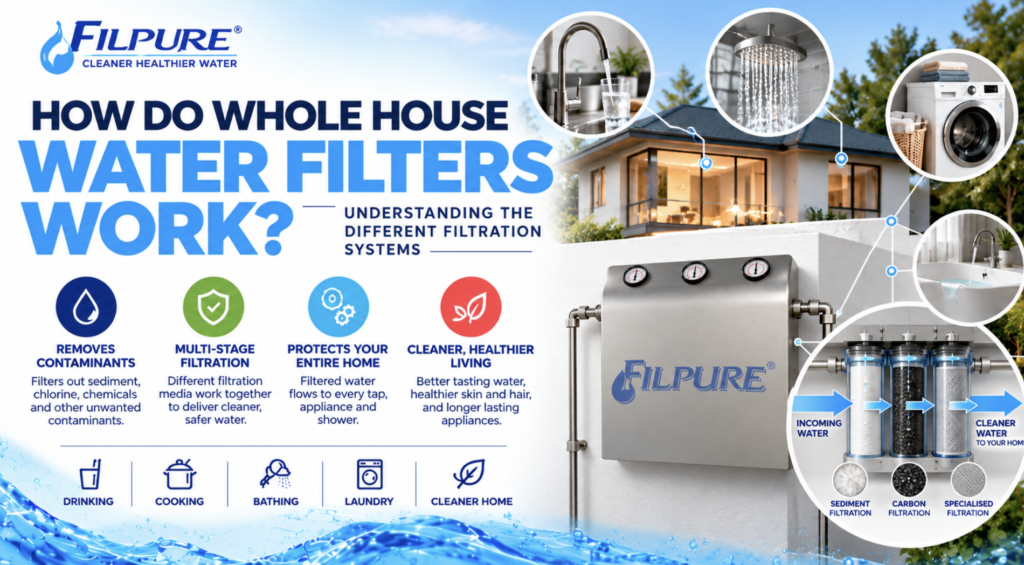
When homeowners start researching water filtration, one of the most common questions is how a filtration system actually works.
While the concept of filtering drinking water is familiar, whole house water filtration operates on a much larger scale.
Instead of filtering water from one tap, a whole house water filter is designed to treat water as it enters the property’s plumbing system, helping improve water quality across multiple household outlets.
Depending on the system, filtration may involve removing sediment, reducing chlorine taste and odour, or using specialised media to address particular substances.
Understanding these processes is important because different filtration technologies achieve different results.
In this guide, we’ll explain how whole house water filters work, the different filtration stages available and what homeowners should know about system performance, installation and maintenance.
What Is a Whole House Water Filtration System?
A whole house water filtration system is installed at the main water supply entry point of a property.
Its purpose is to treat incoming water before it reaches the home’s internal plumbing network.
This arrangement is known as point-of-entry filtration.
Rather than installing individual filters at kitchen taps, bathroom outlets and laundry connections, the homeowner can use one central filtration system to treat water supplied to multiple areas.
The system may contain a single filtration cartridge or several stages that perform different functions.
For example, one stage may capture sediment while another reduces chlorine taste and odour.
The filtration process depends on the media used, the quality of the incoming water and the system’s operating conditions.
The Whole House Water Filtration Process Explained
Although systems vary, most whole house water filters follow a similar operating sequence.
Typical multi-stage filtration process
Incoming water supply
Water enters the property
Stage 1 – Sediment filtration
Captures suitable suspended particles
Stage 2 – Carbon filtration
Reduces chlorine taste and odour
Optional specialised treatment
Selected according to water quality needs
Filtered water to household outlets
Kitchen, bathroom and laundry
Illustrative process only. The actual stages depend on the selected system.
Step 1: Water Enters the Filtration System
Incoming water is directed through the filtration equipment before reaching the household’s internal distribution network.
A suitable installation location allows the system to treat water intended for the desired outlets.
Step 2: The Sediment Filter Captures Particles
Many systems begin with a sediment filter.
This stage captures suspended particles such as dirt, sand and rust, helping reduce the amount of visible debris travelling through the plumbing.
It can also help protect finer downstream filtration media from premature blockage.
Step 3: Carbon or Other Filtration Media Treats the Water
Water may then pass through activated carbon or specialised filtration media.
The purpose of this stage depends on the system configuration.
Activated carbon commonly targets chlorine taste and odour, while specialised media may address other substances identified in the product’s specifications.
Step 4: Water Flows to Household Outlets
Once water has passed through the filtration stages, it continues through the property’s plumbing.
Connected taps, showers and appliances can then receive water treated by the central filtration system.
What Are the Different Types of Whole House Water Filters?
Understanding the different filtration technologies is one of the most important parts of choosing a suitable system.
Each type of filter has a particular function, and some systems combine several technologies to address multiple water quality concerns.
Sediment Filtration Systems
Sediment filtration is commonly used as the first stage in a whole house water filtration system.
These filters are designed to capture suspended particles.
Depending on the cartridge design, they may reduce sand, dirt, rust and other particulate matter.
Sediment filters are available with different micron ratings.
A micron rating describes the approximate size of particles the filter is designed to capture, although actual performance also depends on whether the rating is nominal or absolute.
A finer filter may capture smaller particles, but it can also introduce additional resistance to water flow and may require more frequent replacement in sediment-heavy conditions.
The right sediment filter should balance filtration requirements with the household’s water demand.
Activated Carbon Filtration Systems
Activated carbon is widely used in household water filtration because of its ability to reduce certain taste- and odour-causing substances.
Carbon filtration works through adsorption.
This means certain substances are retained on the surface of the carbon media as water passes through.
One of its most common applications is reducing chlorine taste and odour.
Activated carbon filters may also be designed to reduce certain organic compounds, depending on the media, contact time and product specifications.
However, carbon filters do not automatically remove all chemicals, dissolved minerals or microorganisms.
Homeowners should always check the stated capabilities of the selected filter.
Multi-Stage Whole House Filtration Systems
Multi-stage filtration systems combine different treatment processes.
A common arrangement includes sediment filtration followed by activated carbon treatment.
This approach allows the system to address more than one water quality concern.
For example, the sediment stage captures particles, while the carbon stage targets chlorine-related taste and odour.
Some multi-stage systems incorporate additional filtration media for particular substances.
Filpure’s whole house water filter collection includes different system configurations, including high-flow and multi-stage options.
Choosing the correct combination depends on the incoming water quality and the household’s treatment objectives.
Ultraviolet Water Treatment
Ultraviolet, or UV, water treatment uses ultraviolet light to inactivate susceptible microorganisms.
Unlike sediment or carbon filtration, UV treatment is a disinfection process rather than a conventional particle-removal process.
Its effectiveness depends on several factors, including water clarity, UV dose, flow rate and equipment maintenance.
UV systems do not remove dissolved chemicals or sediment, which is why they may be used alongside other treatment stages.
Where microbiological safety is a concern, professional assessment and appropriate water testing are essential.
Specialised Filtration Media
Some water supplies require treatment beyond standard sediment and carbon filtration.
Specialised media may be designed to address particular contaminants, including certain metals or other identified substances.
For example, a system intended to reduce PFAS should have appropriate performance evidence for the specific compounds being targeted.
The presence of specialised media does not mean the system removes every contaminant.
Performance should always be assessed against the manufacturer’s specifications and relevant test results.
What Is the Difference Between Single-Stage and Multi-Stage Filtration?
Single-stage and multi-stage systems can both be useful, depending on the intended application.
| Single-stage filtration | Multi-stage filtration |
| Uses one primary filtration stage | Combines two or more treatment stages |
| Suited to a defined filtration objective | Can address multiple water quality concerns |
| Generally simpler configuration | More filtration components to maintain |
| Performance depends on selected cartridge | Performance depends on combined media and system design |
A single-stage sediment filter may be appropriate where the main concern is visible particles.
A multi-stage system may be more suitable when homeowners want to address sediment and chlorine-related taste and odour together.
More stages do not necessarily guarantee better results. The important consideration is whether each stage serves a useful purpose.
How Does Water Flow Rate Affect Filtration Performance?
Flow rate is an important consideration for whole house filtration because several household outlets may operate simultaneously.
For example, someone may be showering while a washing machine is running and another person is using the kitchen tap.
A filtration system must be capable of handling the expected water demand.
If the system is too small, water flow may become restricted.
Flow rate can also affect treatment performance because some filtration media require sufficient contact time with the water.
A suitable system should balance water flow, filtration performance and pressure requirements.
This is particularly important for larger households or properties with multiple bathrooms.
Does Whole House Filtration Remove Everything from Water?
No single filtration system should be assumed to remove every substance from water.
Different technologies are designed for different purposes.
Sediment filters capture particles, activated carbon targets certain taste- and odour-related substances, and specialised treatment methods address other identified concerns.
Some dissolved contaminants require technologies that are not included in standard whole house filtration systems.
Water testing can help identify which treatment methods are appropriate when a particular contaminant is suspected.
For a broader overview of the benefits, system types and purchasing considerations, explore our main guide, Whole House Water Filters: The Complete Guide to Benefits, How They Work & Choosing the Right System.
How Are Whole House Water Filters Maintained?
Regular maintenance helps a filtration system continue operating as intended.
Sediment filters gradually accumulate captured particles, which can restrict water flow.
Activated carbon cartridges also have a finite treatment capacity.
Once a cartridge reaches the end of its recommended service life, its ability to reduce certain substances may decline.
Maintenance generally involves inspecting the system, replacing cartridges and following the manufacturer’s servicing instructions.
UV systems, where fitted, have additional maintenance requirements relating to the lamp, sleeve and associated components.
Replacement schedules should be based on the particular equipment and water conditions.
Frequently Asked Questions About Whole House Filtration
How long does water take to pass through a whole house filter?
Water flows through the system as household outlets are used. The treatment time depends on the flow rate, filter design and filtration media.
Do whole house filters need electricity?
Many sediment and carbon filtration systems operate using existing water pressure and do not require electricity. Systems with UV treatment or powered components may need an electrical connection.
What happens when a filter becomes blocked?
A blocked sediment cartridge may reduce water flow or increase pressure loss. Regular replacement helps prevent excessive restriction.
Can different filter cartridges be combined?
Some systems are designed to accommodate different cartridge types. Compatibility, housing dimensions, flow requirements and manufacturer instructions should always be checked before making changes.
Understand Your Water Filtration Options with Filpure
Understanding how whole house water filters work makes it easier to select equipment that matches your household’s requirements.
Whether you need sediment filtration, activated carbon treatment or a multi-stage system, choosing the right technology is essential to achieving your desired results.
Filpure offers a range of filtration solutions for different household water quality needs, including high-flow and specialised systems.
Ready to explore a whole-home filtration solution?
View Filpure’s Whole House Water Filters and enquire about the most suitable filtration configuration for your property.
Search
Blogs

Get Your Water Filter Today – Because Health Can’t Wait!
Prioritize your health — get your water filter today and start living a healthier life. Pure water in every sip, better living every day!
FROM THE AUTHOR