



Whole House Water Filters: The Complete Guide to Benefits, How They Work & Choosing the Right System
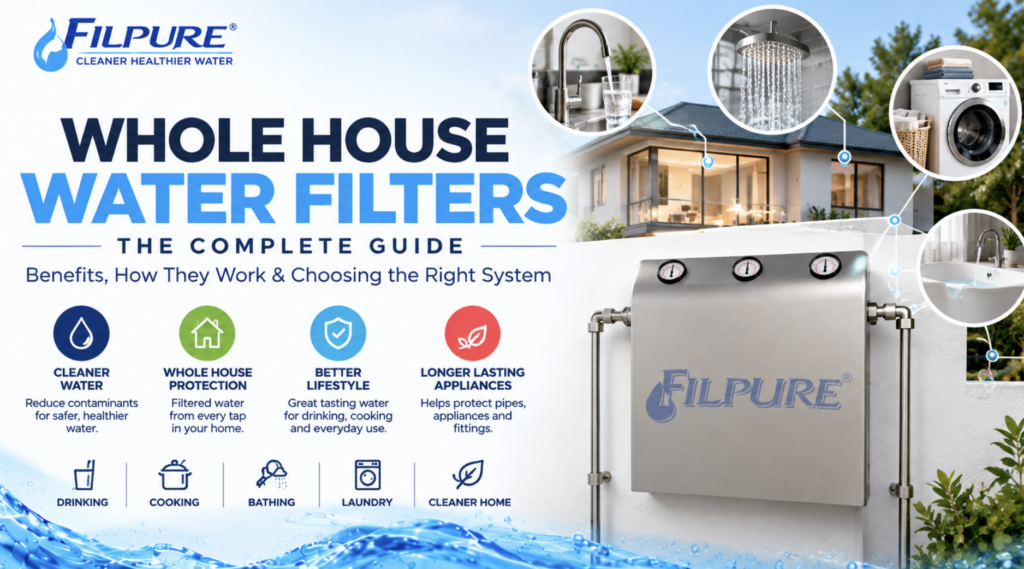
A reliable supply of clean, pleasant-tasting water is an important part of everyday life. From drinking and cooking to showering, washing clothes and cleaning around the home, water plays a role in almost everything we do.
While many households focus on filtering drinking water at the kitchen tap, water quality can also influence other everyday activities. Chlorine taste and odour, sediment, mineral deposits and other water characteristics can affect how water looks, smells and performs throughout the home.
This is where whole house water filters can make a meaningful difference.
Unlike individual tap filters or benchtop filtration units, a whole house water filter is designed to treat water as it enters your home’s plumbing system. This means filtered water can be supplied to multiple outlets, including kitchen taps, bathrooms, showers and laundry appliances.
But how do these systems work? What are the benefits of installing one? And how do you choose the right filtration solution for your household?
In this complete guide, we’ll explore everything homeowners should know about whole house water filtration, from the different technologies available to the practical considerations that can help you make an informed decision.
Whether you’re looking to improve the taste of your drinking water, reduce sediment or create a more convenient water filtration solution, understanding your options is the first step.
What Is a Whole House Water Filter?
A whole house water filter is a filtration system installed at or near the main water supply entry point of a property. Its purpose is to filter water before it travels through the home’s internal plumbing and reaches individual taps, showers and appliances.
These systems are often referred to as point-of-entry water filtration systems because they treat water at a central location rather than at a single outlet.
Traditional drinking water filters generally treat water from one tap. A whole house system takes a broader approach by allowing multiple areas of the home to benefit from filtration.
Depending on the system selected, whole house filtration may help reduce:
- Sediment, including dirt, sand and rust particles.
- Chlorine taste and odour.
- Certain organic compounds and other substances identified in the filter’s specifications.
- Visible particles that can affect water clarity.
It’s important to understand that not every filtration system removes the same substances. The results depend on the filter media, design, water conditions and any relevant performance certifications.
For homeowners interested in exploring available options, Filpure offers a dedicated range of whole house water filters designed for whole-home filtration applications.
How Do Whole House Water Filters Work?
Whole house water filtration operates on a relatively straightforward principle: water passes through one or more filtration stages before being distributed throughout the home.
Although the technology varies between systems, the general process follows several steps.
1. Water Enters the Main Filtration System
Water enters the property through the main supply line and passes into the installed filtration system.
Because the filter is positioned before the water branches into different areas of the home, it can treat water intended for multiple outlets.
The installation location is important because it determines which parts of the property receive filtered water.
2. Sediment and Larger Particles Are Captured
Many whole house water filters include a sediment filtration stage.
Sediment filters are designed to capture suspended particles such as sand, dirt, rust and other debris that may be present in the water supply.
Removing these particles can help improve water clarity and reduce the amount of sediment travelling through the household plumbing system.
It may also help protect downstream filtration components from premature blockage.
3. Additional Filtration Media Treat the Water
Depending on the system, water may then pass through activated carbon or other specialised filtration media.
Activated carbon is commonly used to reduce chlorine taste and odour, helping make water more pleasant for everyday use.
Some systems incorporate additional treatment technologies to address particular water quality concerns.
The important distinction is that each filtration stage has a specific purpose. A system should be selected according to the substances you want to reduce rather than assuming all filters provide identical results.
4. Filtered Water Is Distributed Throughout the Home
After passing through the filtration stages, water continues through the property’s plumbing system.
This allows the household to access filtered water from connected taps, showers and appliances without requiring a separate filter at every outlet.
The actual filtration results depend on the system configuration and its suitability for the water supply.
For a more detailed explanation of filtration stages, read our upcoming guide, How Do Whole House Water Filters Work? Understanding the Different Filtration Systems.
What Are the Main Benefits of Whole House Water Filters?
Installing a whole house water filter can provide several practical advantages, particularly for households looking for a convenient way to manage water quality across multiple areas.
Improved Water Taste and Odour
One of the most common reasons homeowners consider water filtration is to improve the taste and smell of their water.
Chlorine is widely used in treated water supplies for disinfection. Although it plays an important role in water treatment, some people notice its taste or odour.
Whole house filtration systems containing suitable activated carbon media can reduce chlorine taste and odour, making water more enjoyable for drinking, cooking and other household uses.
Filtration Beyond the Kitchen
A standard drinking water filter usually treats water from one designated outlet.
Whole house filtration extends treatment to multiple areas of the property.
This can be particularly appealing for households wanting filtered water for showering, bathing, laundry and general cleaning rather than limiting filtration to drinking water alone.
Reduced Sediment in Household Water
Sediment can enter water supplies from several sources, including pipework, water infrastructure and certain source-water conditions.
A suitable sediment filtration stage can capture particles before they travel through the home’s plumbing.
This may reduce visible debris in water and help minimise sediment accumulation in some downstream fixtures and appliances.
Greater Everyday Convenience
A central filtration system can reduce the need to maintain multiple individual filters around the home.
Rather than installing separate filtration devices at different outlets, homeowners can manage filtration through one central system.
Filters still require regular maintenance, but the arrangement can offer a more streamlined approach to household water treatment.
Support for Household Fixtures and Appliances
Sediment can accumulate in tap aerators, showerheads and appliance inlet screens.
By capturing suitable particles before they reach these areas, a whole house sediment filter may help reduce certain sediment-related maintenance issues.
However, sediment filtration should not be confused with water softening. Standard sediment and carbon filters do not necessarily remove dissolved minerals responsible for hard-water scale.
A More Consistent Household Water Experience
When a properly sized system treats the main supply, multiple connected outlets can receive water that has passed through the same filtration process.
For households seeking a consistent approach to water filtration, this can be a practical advantage.
For more information, explore our supporting article, What Are the Benefits of Installing a Whole House Water Filter?
Understanding the Different Types of Whole House Water Filtration Systems
Not all water filters use the same technology, and understanding the differences is essential when selecting a suitable system.
Sediment Water Filters
Sediment filters are designed to remove suspended particles from water.
They are commonly used as the first stage of a multi-stage filtration system because they help capture larger particles before water reaches finer filtration media.
These filters can be particularly useful where water contains visible sediment or particulate matter.
Activated Carbon Water Filters
Activated carbon filters are widely used to reduce chlorine taste and odour.
Carbon works through a process called adsorption, where certain substances are retained on the surface of the filtration media.
Different carbon filter designs can have different capabilities, so homeowners should check the specifications of the individual system.
Multi-Stage Whole House Water Filters
Multi-stage systems combine different filtration technologies in a single arrangement.
For example, a system may use sediment filtration followed by activated carbon treatment.
This combination allows the system to address different water quality concerns through separate filtration stages.
Multi-stage filtration can be an attractive option for homeowners seeking both particle reduction and improved water taste and odour.
Specialised Water Treatment Systems
Some properties have water conditions requiring more specialised treatment.
Depending on the issue, additional technologies may include water softening, ultraviolet disinfection or other treatment methods.
These solutions should be selected based on actual water quality requirements.
A standard whole house sediment and carbon filtration system should not be assumed to remove all dissolved contaminants, microorganisms or hardness minerals.
Whole House Water Filters vs Under-Sink Water Filters
Both whole house and under-sink filtration systems can be useful, but they serve different purposes.
| Feature | Whole house filtration | Under-sink filtration |
| Installation location | Main water supply | Individual kitchen outlet |
| Coverage | Multiple household outlets | Usually one drinking water outlet |
| Primary purpose | General household filtration | Targeted drinking water filtration |
| Filtration technologies | Sediment, carbon and specialised options | Carbon, reverse osmosis and other options |
| Maintenance | Centralised filter servicing | Individual unit servicing |
A whole house system is generally suited to homeowners wanting filtration across multiple household outlets.
An under-sink filter may be more appropriate where the primary concern is drinking and cooking water from one tap.
Some households choose to combine both approaches, using whole house filtration for general household water treatment and a dedicated drinking water system for more targeted filtration.
The best option depends on the water supply, household requirements and filtration objectives.
How to Choose the Right Whole House Water Filter
Selecting a whole house water filter involves more than choosing a particular filter size or number of filtration stages.
The most effective approach is to identify what you want to improve about your water and then match those requirements to a suitable system.
Identify Your Water Quality Concerns
Start by considering why you want filtration.
Are you noticing the chlorine taste or odour? Is there visible sediment in your water? Are you concerned about particular substances?
Different concerns may require different treatment methods.
Where water quality is uncertain, suitable testing can provide more useful information than selecting a filter based on assumptions.
Consider Your Household Water Usage
The number of bathrooms, occupants and frequently used appliances can influence the flow rate required.
A filtration system must be capable of supplying enough water for normal household activities.
If the system is undersized, water pressure and flow may be affected when several outlets operate at once.
Understand Flow Rate and Water Pressure
Flow rate describes how much water can pass through the filtration system over a given period.
A suitable whole house water filter should support the household’s expected peak water demand while maintaining acceptable pressure.
Filter size, cartridge condition and plumbing configuration can all influence performance.
Compare Filtration Stages
More filtration stages do not automatically mean better filtration.
The value of a particular stage depends on the water quality issue it is designed to address.
For example, a sediment filter may be useful for visible particles, while activated carbon may be more appropriate for chlorine taste and odour.
Choose a configuration that matches your actual needs.
Review Maintenance Requirements
All filtration systems require some level of ongoing care.
Before purchasing, consider cartridge replacement intervals, replacement filter availability, servicing requirements and the overall cost of ownership.
A system that is easy to maintain can provide a better long-term experience.
Check Installation Requirements
Whole house water filters are connected to the property’s main water supply and generally require professional plumbing installation.
The installer should assess the available space, pipework, water pressure and any applicable installation requirements.
Planning the installation properly can help ensure the system operates as intended.
For a practical buying checklist, read our upcoming article, How to Choose the Best Whole House Water Filter for Your Home.
Where Should a Whole House Water Filter Be Installed?
Whole house water filters are typically installed at a point where incoming water can be treated before it branches to household outlets.
The exact location depends on the property’s plumbing layout and the areas requiring filtration.
An appropriate installation location should provide enough space for the filter housings, allow convenient cartridge replacement and protect the equipment from unsuitable environmental conditions.
Accessibility is particularly important.
Filters need periodic servicing, and a system installed in a difficult-to-reach location may become inconvenient to maintain.
A qualified plumber can help determine the most appropriate position and whether additional plumbing components are required.
How Often Should Whole House Water Filters Be Replaced?
Filter replacement is an essential part of maintaining a whole house filtration system.
Over time, sediment filters accumulate captured particles, while activated carbon media gradually reaches the limits of its useful treatment capacity.
Replacement frequency varies according to several factors, including:
- The manufacturer’s recommended service interval.
- The quality of incoming water.
- Household water consumption.
- Filter type and capacity.
- Changes in water pressure or filtration performance.
Some cartridges may require replacement more frequently than others.
Homeowners should follow the manufacturer’s maintenance schedule rather than relying solely on visible changes in water quality.
A filter may become less effective even when the water continues to look clear.
Are Whole House Water Filters Worth It?
For many households, the value of whole house filtration comes from convenience, coverage and the ability to address specific water quality concerns across multiple outlets.
A suitable system can provide filtered water for a broader range of everyday activities without relying on separate filters throughout the home.
However, whether a system is worthwhile depends on what you want it to achieve.
If your only concern is improving drinking water from the kitchen tap, a dedicated under-sink system may be sufficient.
If you want to reduce sediment or chlorine taste and odour throughout the property, whole house filtration may be a more practical solution.
The key is choosing a system with capabilities that match your water supply and expectations.
Common Questions About Whole House Water Filters
Do whole house water filters remove chlorine?
Whole house systems containing suitable activated carbon media can reduce chlorine taste and odour. The level of reduction depends on the filter’s specifications, operating conditions and maintenance.
Can a whole house water filter improve shower water?
A whole house filter can treat water supplied to showers if those outlets are connected downstream of the system. The benefits depend on the substances the filter is designed to reduce.
Do whole house water filters remove hard water?
Standard sediment and carbon filters generally do not remove the dissolved calcium and magnesium responsible for water hardness. A suitable water softening or specialised treatment system may be required.
Will a whole house water filter reduce water pressure?
Any filtration system introduces some resistance to water flow. A correctly sized, properly maintained system should be selected to minimise unwanted pressure loss under normal household conditions.
Can whole house water filters make unsafe water safe to drink?
Not necessarily. Different systems target different substances, and ordinary sediment or carbon filters should not be relied upon to make microbiologically unsafe water potable. Appropriate testing and treatment are essential when water safety is uncertain.
Can I install a whole house water filter myself?
Installation involves connecting equipment to the main plumbing supply. A suitably licensed plumber should assess and perform the installation in accordance with applicable requirements.
Make Better Water Filtration Part of Everyday Living
Choosing the right whole house water filter is about finding a practical solution that suits your water supply, household needs and expectations.
From reducing sediment to improving chlorine-related taste and odour, the right filtration system can make everyday water use more convenient across the home.
At Filpure, homeowners can explore whole house filtration options and compare systems to find a suitable solution for their requirements.
Ready to improve your household water filtration?
Explore Filpure’s Whole House Water Filters collection and take the next step towards a more convenient whole-home filtration solution.
Search
Blogs

Get Your Water Filter Today – Because Health Can’t Wait!
Prioritize your health — get your water filter today and start living a healthier life. Pure water in every sip, better living every day!
FROM THE AUTHOR